



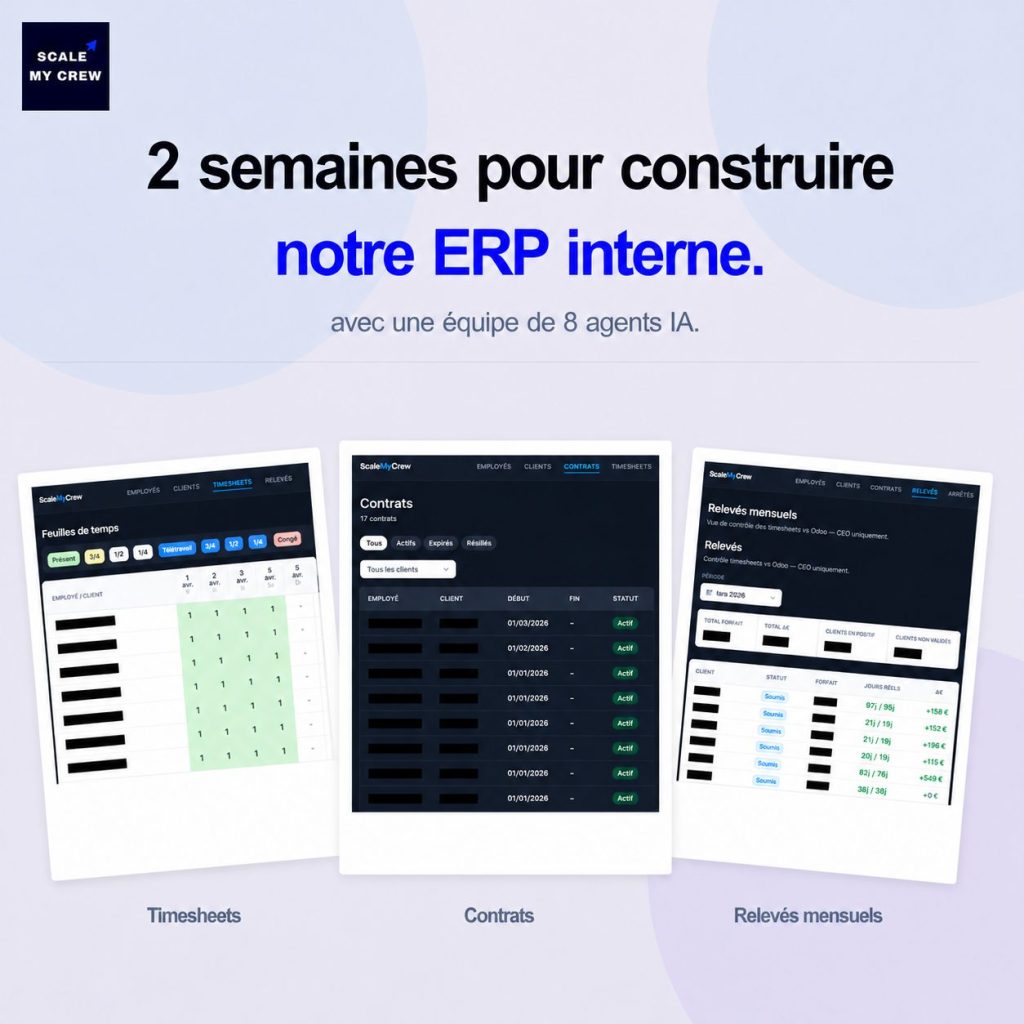
We could have spent months thinking about it. We preferred to build.
At ScaleMyCrew, we support European SMEs with dedicated teams in Madagascar. But we asked ourselves a simple question: can we go further than recruitment? Can we also help our clients work better, with better tools?
To answer it, we did not commission a study. We launched an internal project. We tested, we failed and we corrected.
In just 2 weeks, a single AI expert developed our internal ERP, managed by a team of 8 AI agents. Each with a precise role: architect, coder, tester, deployer, documenter… All structured, documented, reproducible.
In this article, we explain how we built them, what we learned along the way, and why this approach concretely changes the way of working, for us first, and soon for our clients.
How we structured our ERP
An ERP is simply a tool that brings a company’s key operations together in one place. For us: employee management, client management, contracts, time tracking and invoicing. Before, all of this was scattered across Excel files, emails and tools that did not communicate with each other. Now, everything is in one place.
We started by identifying what we truly needed. We wanted something lightweight, without superfluous features, adapted to our offshore operations and directly usable by our teams in Madagascar.
To build it, we relied on a team of AI agents, from design to production, including testing and documentation. What was most instructive for us was not the speed of execution. It was the method we built along the way: structure, document, adjust. The objective was not just to produce a tool for ourselves, it was to understand how to reproduce it for our clients.
What working with AI agents taught us
An AI agent is a program that executes a specific task autonomously, based on clear instructions.
For the construction of our ERP, we set up a team of 8 agents, each with a well-defined role: an architect to think through the structure, a coder to produce, a DBA for the database, a reviewer to proofread, a tester and an E2E tester to control, a deployer to go live, and finally a scribe to document everything.
What we quickly understood: working with AI agents is not just automation. It is team management. You have to brief, control and correct exactly as you would with humans.
Here is what it taught us concretely.
AI executes only what you ask of it, nothing more. If instructions lack clarity, the result suffers directly. You therefore need to be precise, get to the point and avoid overloading.
You also need to verify what comes out. A rule only has value if its application is visible in the final result.
Finally, you need to accept that it sometimes fails. AI makes mistakes, like any team member. You correct, adjust and move on.
Our next step: automating our content production, from idea sourcing to publication.
How we will integrate this with our clients
What we built internally is not just for us.
We want to offer our clients more than a team: concrete and useful tools. A simple and intuitive ERP to monitor their offshore team in Madagascar, and AI agents to automate the tasks that are wasting their time.
The ERP centralizes everything related to their organization: contracts, hours worked and invoicing. AI agents, meanwhile, allow dedicated teams in Madagascar to offload what is repetitive and time-consuming: client follow-ups, payment tracking, weekly reporting.
What seems important to us to highlight is that we are not starting from a theoretical concept. We use these tools on a daily basis. We know what works, where it gets stuck and the elements that need to be adjusted. It is this concrete experience that we want to transpose to our clients.
The concrete impact on our organization
Before, our information was scattered across multiple files. Today, everything is centralized: employees, clients, contracts, time and invoicing.
Concretely, this translates into simple but daily-useful features: daily rate management, automatic timesheet generation, invoicing, invoice details and monthly statements. In summary, everything that was done by hand now runs automatically.
We are also moving forward on other operational subjects. We are currently working on recruitment, with the objective of automating part of the sourcing, application tracking and interview preparation.
In parallel, we are developing our content creation, with the objective of setting up an AI-assisted editorial machine, from idea sourcing to scheduling and publication.
These tools do not replace work. They simply streamline what we do daily, automate what can be automated, and improve the quality of what we produce. In this way, we make fewer errors, avoid repeating the same tasks unnecessarily and maintain a better level of rigor in what we deliver.
Questions we are often asked about AI agents
Conclusion: concrete results, not theory
Our model is not perfect, nor are our tools. But in 2 weeks we built something concrete that we genuinely use on a daily basis.
We learned by doing. We failed, we corrected, we documented each step and now we are ready to explore how to reproduce this for our clients.
In summary, this is our approach at ScaleMyCrew: test internally, document what works, and deploy it for our clients. No theory. Just concrete results.
Publié le 04/05/2026