


More and more European SME leaders are turning to offshore collaboration to save time, structure their organisation, or absorb a workload that has become too heavy. On paper, the promise is clear: skilled profiles, available resources, and controlled costs. Yet in reality, many offshore collaborations leave a feeling of unfinished business.
The problem is almost never the country. Nor is it the skill level of the team members. In most cases, disappointment comes from how the collaboration was designed from the very beginning. Too often, offshore is approached as a simple capacity extension, with no real thought given to how the team operates, how it integrates, or the role it is meant to play.
Leaders who have already tried offshore often say the same thing. Tasks move forward, but fluidity is missing. Back-and-forth increases. Mental load remains high. The expected sense of relief never truly materialises. On the other hand, those who are still hesitant fear losing control or having to manage even more than before.
Creating value through offshore collaboration is therefore not about a magic formula. It relies on a few simple but structuring fundamentals. Key principles that transform a remote collaboration into a real lever for organisation and performance for an SME.
Point #1: Understand the company before executing, the foundation of any truly effective collaboration
An offshore collaboration cannot work sustainably if the team limits itself to executing isolated tasks. Executing without understanding the context is like moving forward without a compass. Deliverables are produced, but not always in the right direction.
For an offshore team to create real value, it must understand the company it is joining. Its activity, its clients, its constraints, its priorities, and its way of working. This does not mean explaining everything in detail, but sharing what truly matters.
In an SME, many decisions rely on implicit trade-offs. What is urgent. What is important. What can wait. A local team often picks up on these elements naturally. An offshore team, however, needs them to be made explicit.
When the offshore team understands the company’s internal logic, the nature of its work changes. It no longer just executes. It anticipates, adjusts, and asks better questions. Value appears precisely at that moment, when the team works with the same level of understanding as local teams, even at a distance.
Point #2: An integrated dedicated team, not an interchangeable resource
There is a fundamental difference between a one-off external resource and a dedicated team integrated into the organisation. An interchangeable resource executes what is requested and then disappears from the scope. A dedicated team, on the other hand, is built for the long term.
In offshore collaboration, value is rarely created in the short term. It is built through continuity, stability, and progressive skill development. A dedicated team learns the company, its habits, its standards, and its evolution over time. It builds on experience, whereas a temporary resource always starts from scratch.
For an SME, this continuity changes everything. Decisions are faster. Errors are repeated less often. The team gains real autonomy. The leader no longer needs to constantly revalidate everything.
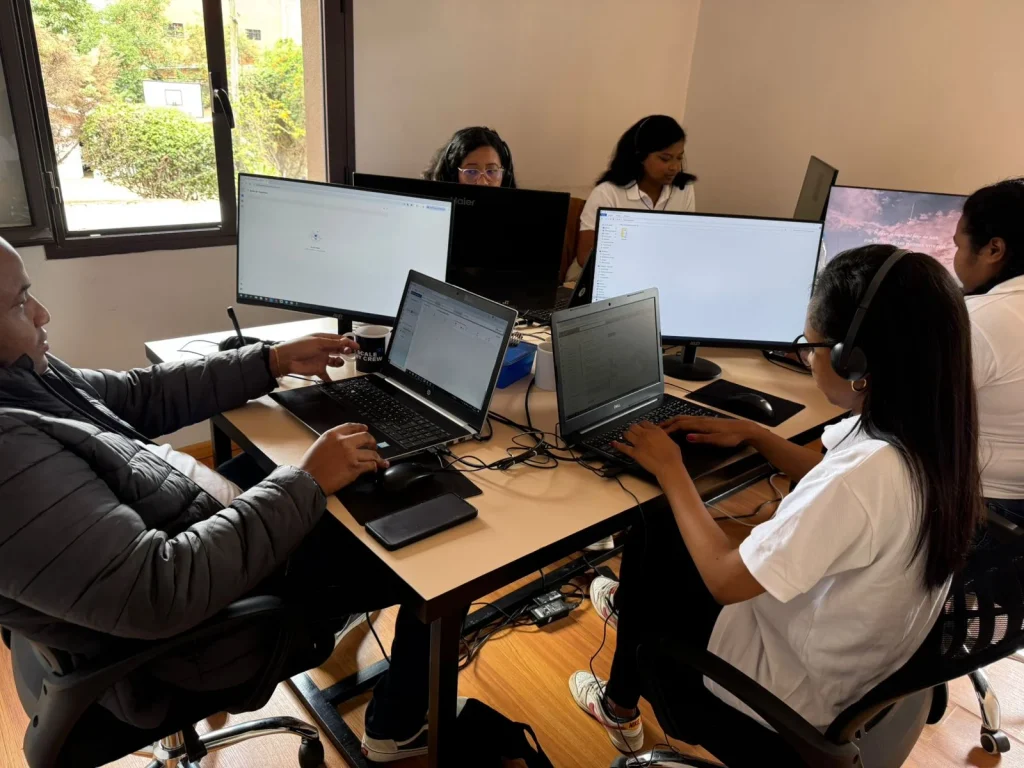
When the offshore team becomes a natural extension of the company, the collaboration takes on a completely different dimension. It is no longer perceived as a risky delegation, but as a reliable pillar of the organisation. This is exactly how offshore teams in Madagascar can become a real strategic asset, rather than a short-term solution.
Point #3: A clear and shared working framework
What turns effort into performance
Many frictions in offshore collaborations do not come from people, but from a lack of structure. Unclear priorities. Implicit rules. Processes that are never truly formalized. At a distance, this lack of clarity is costly in both energy and time.
A clear working framework does not make collaboration rigid. It makes it smoother. It allows everyone to know how to work, with which tools, according to which priorities and at what time. This framework provides stable reference points, which are essential for an offshore team.
Sharing key processes, explaining the tools used, clarifying operating rules and expectations allows the team to work with greater peace of mind. They no longer waste time guessing. They can focus on what truly creates value. With an offshore team in Madagascar, this framework is even more important because it compensates for the absence of informal interactions. When well defined, it becomes a driver of autonomy and performance, not an additional constraint.
Point #4: Moving from execution to guidance: where real value is created
An offshore collaboration that truly creates value is not limited to responding to requests. It supports, it alerts, it makes suggestions, it adjusts, and it shares responsibility for results.
This shift in posture is often gradual. It emerges when the team understands the business, commits for the long term and operates within a clear framework. At this stage, the offshore team no longer works only on what is requested, but on what is actually useful.
For the business leader, this evolution deeply changes day-to-day operations. They no longer carry the operational vision alone. They can rely on a team capable of identifying weak signals, suggesting improvements and anticipating needs. This is precisely where offshore work stops being a simple execution solution and becomes a true lever for structure and performance for the SME.
FAQ — The questions business leaders ask before committing to an offshore collaboration
Conclusion: an offshore collaboration that becomes a true lever for the SME
A successful offshore collaboration is based neither on a country nor on a cost promise. It relies above all on people, structure and a long-term vision. Understanding the business before executing, integrating a dedicated team, establishing a clear framework and evolving toward a guidance-driven approach are the true pillars of value creation.
When these elements come together, offshore work stops being a short-term solution. It becomes a reliable pillar of the organization. A dedicated team in Madagascar can then fully integrate into the SME’s dynamics, support its growth and contribute sustainably to its performance.
This is the structured, human and pragmatic approach defended by ScaleMyCrew. Not to make offshore work a simple operational response, but to turn it into a real lever for organization and peace of mind for European SME leaders.
If you too want to structure your company with a dedicated team in Madagascar, contact us to discuss it and discover how this model can be adapted to your needs.
Publié le 26/12/2025